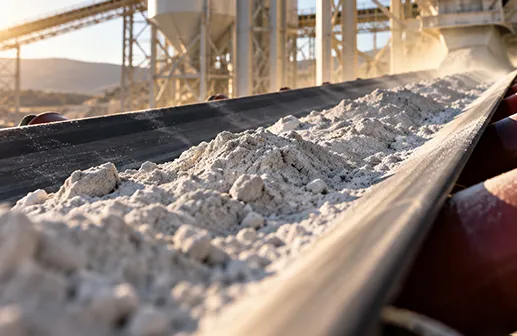
The powdered cement is a binding material obtained through an industrial process that starts from mineral raw materials and results in a fine powder used in concrete batching plants, construction sites, plants for the production of concrete and many industrial applications.
When asking how powdered cement is made, it is important to distinguish cement from concrete. Cement is the powdered binder; concrete, on the other hand, is the material obtained by mixing cement, water, sand, gravel or other aggregates. For this reason, cement is produced in cement plants and then stored in silos, transported, dosed and used in different production processes.
Which raw materials are used to produce cement?
Cement production starts from natural raw materials such as limestone, clay, marl and corrective materials. These materials are extracted, crushed and prepared to obtain a mixture with controlled chemical characteristics.
The composition of the mixture is fundamental because it affects the quality of the final product. Cement must guarantee binding capacity, mechanical strength and consistent behaviour when mixed with water and aggregates to produce concrete.
How cement is made: the main phases
The production process of powdered cement includes several phases. Each step helps transform the raw material into a fine, stable product suitable for use in construction and industrial processes.
- extraction of raw materials;
- crushing of limestone, clay and corrective materials;
- preparation and grinding of the raw mix;
- burning in the cement plant kiln;
- formation of clinker;
- cooling of clinker;
- cement grinding using clinker, gypsum and other components;
- storage of powdered cement in silos;
- transport of bulk cement to concrete batching plants, construction sites, port terminals or other users.
What is clinker?
Clinker is the intermediate material from which cement is obtained. It forms during the high-temperature burning of the raw material mixture. After cooling, it appears as small hard granules that must be finely ground.
The grinding of clinker takes place together with gypsum and, depending on the type of cement, other mineral components. This phase produces powdered cement, ready to be stored, transported and used in concrete production.
Cement grinding and powder characteristics
Cement grinding is a decisive phase because it determines the fineness of the powder and affects the product’s performance. Correct grinding makes it possible to obtain a homogeneous cement, suitable for dosing and mixing in concrete batching plants.
In some applications, there is also talk of cement mix and marble powder, especially when cement is combined with mineral powders or fine materials to obtain specific technical mixes, mortars, finishes or special products. In these cases, it is even more important to control dosing, mixing and the quality of the powders used.
Why silos are important for powdered cement
Silos for cement are fundamental because they make it possible to store powdered cement in a safe, orderly and controlled way. Cement is a fine bulk material that is sensitive to moisture: for this reason, it must be stored in suitable structures, capable of protecting it from external agents and making it available for discharge, dosing and handling.
A cement silo is not a simple container, but a technical system that can integrate filters, safety valves, level indicators, fluidification systems, extraction screw conveyors, load cells and silo weighing systems. These accessories help ensure safety, dust control, operational continuity and correct material dosing.
Silos for cement and concrete batching plants
In concrete batching plants, powdered cement is stored in dedicated silos. From there, it is extracted, weighed and dosed together with water, sand, gravel and other aggregates to produce concrete.
In a batching plant, silos must ensure continuous feeding, cement protection, level control and dosing accuracy. Correct silo configuration reduces interruptions, material waste, discharge irregularities and problems in concrete production.
Port storage of cement
Powdered cement can also be handled in port contexts, especially when large quantities of bulk cement or other powdered materials need to be handled. Port storage of cement requires high-capacity solutions, suitable for receiving the material, storing it and making it available for subsequent transport or industrial use.
In these contexts, vertical bolted silos are often used, because they make it possible to handle large volumes and optimize logistics. The bolted structure allows the silo to be transported in separate elements and assembled directly at the terminal, making this solution suitable for large projects and complex logistics contexts.
Which silos are used for cement storage?
Different types of silos can be used for cement storage, chosen according to the required capacity, available space, transport method, type of installation and production process.
Vertical silos are suitable for stable configurations and structured industrial systems. Bolted silos are recommended when large storage capacities are required or when transporting a monolithic silo would be complex. Horizontal silos, on the other hand, can be used in contexts where quick installation, mobility and reduced civil works are important.
Poggi silos for cement and bulk materials
Poggi S.p.A. designs and manufactures silos for cement and solutions for the storage and handling of bulk materials and liquid materials, supporting the customer in choosing the most suitable configuration. The aim is not only to supply a product, but to identify a solution consistent with the material to be stored, the required capacity, the installation context and the operational needs.
Poggi support may include technical consulting, design, production, assembly, start-up, accessory configuration and long-term assistance. In this way, the customer is supported in defining the silo, evaluating loading and discharge systems, sizing and integration with concrete batching plants, port terminals or existing industrial systems.
Accessories for cement storage, discharge and dosing
A silo intended for powdered cement must be configured with accessories suitable for the material and the production process. The most important elements may include dust collector filters, safety valves, level indicators, fluidification systems, vibrators, screw conveyor for silos, load cells and weighing systems.
These components make it possible to control loading, support discharge, contain dust, reduce build-ups or flow irregularities and ensure correct dosing. In the case of cement, discharge management is particularly important because the powder can compact or create problems during extraction.
From powdered cement to concrete
Once produced and stored, powdered cement is transported in bulk or packaged to final users. In concrete batching plants, it is taken from the silos, weighed and mixed with water and aggregates to obtain concrete.
Concrete is therefore not powdered cement, but the result of a controlled mixture. Cement acts as a binder: when it comes into contact with water, it starts a reaction that allows the mixture to harden and develop strength over time.
Conclusion
Powdered cement is obtained through an industrial process that includes raw material extraction, crushing, mix preparation, burning in the cement plant, clinker production and final grinding. The product is then stored and handled in a controlled way before being used in concrete batching plants, construction sites, port terminals and concrete production.
In this process, silos play a fundamental role: they protect powdered cement, store it safely, allow correct dosing and make it available for the subsequent phases of the production process.
Poggi S.p.A. supports the customer in choosing silos for cement, sizing, configuring accessories and integrating loading, discharge, weighing and handling systems, offering solutions suitable for concrete batching plants, industrial applications and port storage. To learn more about Poggi silos, click the link: Vertical silos for storage | Poggi s.p.a.