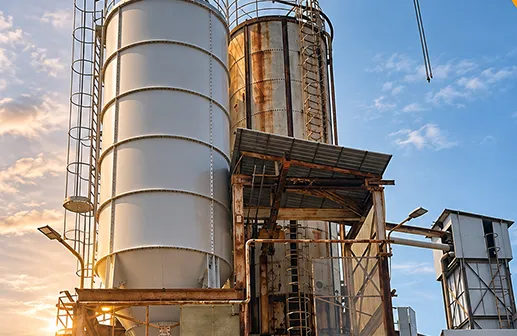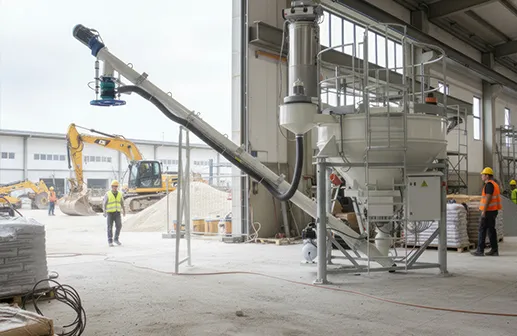
Industrial silo replacement is an operation that requires technical, structural and logistical assessments. Replacing a silo does not simply mean removing an existing structure and positioning a new one: it is necessary to assess site conditions, the characteristics of the stored material, available space and compatibility with loading and unloading systems.
In industrial facilities that are already operational, silo replacement can be particularly complex due to the presence of buildings, pipelines, steel structures, machinery and restricted access routes.
Careful planning makes it possible to identify the most suitable storage solution, assess the necessary operations and minimise interference with production activities. Preliminary assessments become particularly important when replacing silos in confined spaces or in production areas that cannot be completely cleared.
When Is It Necessary to Replace an Industrial Silo?
The decision to replace a silo may depend on various technical and operational requirements. In some cases, the existing structure shows signs of deterioration; in others, replacement is driven by the need to modify storage capacity or adapt the system to new production requirements.
The most common situations include:
- Structural deterioration: corrosion, wear, deformation or other anomalies requiring an assessment of the silo’s structural integrity.
- Changes in storage capacity: the need to increase or reduce the available volume.
- Changes in the stored material: the use of products with different characteristics in terms of bulk density, particle size, moisture content or discharge behaviour.
- Upgrading production processes: new requirements for material loading, extraction, dosing and handling.
- Space reorganisation: changes to the production layout or the need to use the available area differently.
- Technical obsolescence: difficulties in adapting the existing structure to new operational requirements.
The presence of one of these conditions does not automatically mean that the silo must be replaced. Before proceeding, it is advisable to assess the condition of the structure and the possibility of carrying out maintenance, repairs or modifications.
Silo Replacement or Modernisation: Which Solution Should You Choose?
Silo replacement and modernisation address different needs. Before choosing a new product, it is important to establish whether the critical issues concern the main structure, the connected equipment or the performance required by the production process.
The main options are:
- Maintenance and repair: operations intended to resolve specific issues when the condition of the structure and technical assessments allow it to remain in service.
- Silo modernisation: upgrading components, accessories or control systems when the existing structure is still suitable for the intended operating conditions.
- Complete replacement: installing a new silo when the existing structure no longer meets storage requirements or when modification work is not technically appropriate.
The choice requires an assessment of structural conditions, storage capacity, material characteristics and the overall costs of the operation.
Modernisation may be sufficient when the problem concerns a specific piece of equipment, while replacement may be necessary when the configuration or performance of the storage system needs to be substantially modified.
What Assessments Should Be Carried Out Before Replacing a Silo?
Before defining the characteristics of the new product, it is necessary to collect technical information about the existing silo and the area where the new one will be positioned.
The main assessments concern:
- Dimensions and capacity of the existing silo.
- Physical characteristics and behaviour of the stored material.
- Configuration of loading and discharge points.
- Connection heights and positions relative to existing equipment.
- Condition of supporting structures and foundations.
- Available space for the new silo.
- Accessibility for transport and lifting equipment.
- Presence of buildings, pipelines, power lines and other nearby structures.
These data provide the starting point for defining the characteristics of the new silo and assessing the feasibility of the replacement.
Can the Existing Silo Foundations Be Reused?
The possibility of reusing the foundations cannot be taken for granted, even when the new silo has dimensions similar to those of the previous one.
The assessment must consider the loads transmitted by the new structure, the arrangement of the supports, the condition of the concrete, the anchorages and the ground characteristics.
A new silo may have a different load distribution compared with the one being replaced, even with the same nominal capacity.
The possibility of retaining the existing foundations must therefore be confirmed through a specific structural assessment carried out by qualified professionals.
Silo Replacement in Confined Spaces: What Challenges Must Be Addressed?
Replacing silos in confined spaces is one of the situations requiring particular attention when planning the operation.
In existing industrial facilities, available space may be restricted by buildings, steel structures, other storage units, production lines and access routes.
In these cases, it is important to assess not only the final dimensions of the silo but also the space required to transport, handle and position it.
Assessments may include:
- Site access: passage widths, available clearance height, turning radii and vehicle manoeuvring possibilities.
- Lifting space: equipment positioning, operating radii and the presence of obstacles.
- Interference: distances from buildings, other silos, pipelines and infrastructure.
- Working area: availability of space for removing the old silo and positioning the new one.
- Sequence of operations: coordination of activities to reduce interference with other work.
The design of the new silo must take these constraints into account from the earliest stages. A structure that fits within the available installation space may still present difficulties during transport or lifting.
When access is particularly restricted, it is necessary to carefully assess the product dimensions, delivery methods and handling possibilities within the facility.
Industrial Silo Removal: What Should Be Considered?
Industrial silo removal requires specific planning, especially when the structure is located within an operational industrial facility.
Before dismantling or lifting activities, the condition of the structure, the possible presence of residual materials, connections to equipment and access conditions must be assessed.
It is also necessary to define how loading, discharge, filtration, control and supply systems will be disconnected, in accordance with the applicable procedures.
The choice of removal techniques depends on the characteristics of the silo, site conditions and the assessments made by the specialised operators responsible for the operation.
Operations must be planned and carried out by qualified parties, using suitable equipment and in compliance with applicable safety regulations.
How to Choose the New Industrial Silo?
The choice of a new silo must be based on storage requirements and operating conditions, rather than solely on the dimensions of the previous structure.
The main parameters to consider include the required capacity, material characteristics, filling and emptying methods, environmental conditions and integration with existing equipment.
The Poggi range includes different types of vertical silos, each with distinct construction and logistical characteristics.
Monolithic Vertical Silos
Poggi monolithic silos from the SZ, SM and SB series feature a welded structure and are transported with the main silo body already assembled.
This configuration eliminates the need to assemble the silo body on site and may be a suitable solution when the product dimensions and access conditions allow the structure to be transported and positioned.
The choice must nevertheless be assessed in relation to the required capacity, the material to be stored and the constraints of the installation area.
Telescopic Vertical Silos
Poggi telescopic vertical silos from the TC and TP series are designed to reduce overall dimensions during transport thanks to a structure consisting of sliding sections.
The TC series is designed for transport in Open Top containers, while the TP series is designed for transport by truck.
These characteristics may be relevant when assessing the logistics of a replacement operation, although the suitability of the product depends on operational requirements and installation conditions.
Panel-Built Vertical Silos
Poggi panel-built vertical silos from the SPG series consist of steel components connected using high-strength bolts.
The modular structure allows the components to be transported separately and assembled at the installation site.
This solution is particularly suitable for large storage capacity requirements and complex industrial projects. Its possible use in a replacement operation requires an assessment of material characteristics, available space and assembly operations.
Silo Transport and Handling: How Should Operations Be Organised?
Silo transport and industrial silo handling are important stages of a replacement operation, especially when the destination has restricted access or the structure is particularly large.
Planning must consider the overall dimensions of the load, its weight, the type of vehicle required and route conditions.
For positioning, it is also necessary to assess the characteristics of lifting equipment, manoeuvring space, ground conditions and the presence of any obstacles.
For large structures, abnormal load transport and specific permits may be required.
Handling and installation methods must be defined by the responsible qualified parties based on the characteristics of the product and the actual site conditions.
Silo Installation: How to Connect It to Existing Systems?
Installing the new silo may require adapting connections to equipment already present in the industrial facility.
The elements to be checked include:
- Loading systems: position and characteristics of the feeding pipelines.
- Discharge systems: connection heights, geometry and compatibility with downstream equipment.
- Filtration: characteristics of dust collection filters and their connections.
- Level monitoring: position and compatibility of monitoring devices.
- Safety devices: requirements and configurations specified for the new application.
- Weighing systems: possible presence of load cells and the need for integration with control systems.
The possibility of retaining existing equipment must be assessed on a case-by-case basis. Dimensional compatibility alone does not guarantee functional compatibility.
The new silo must be configured according to the characteristics of the stored material and the intended operating conditions.
How Long Does Industrial Silo Replacement Take?
There is no standard duration for industrial silo replacement. The time required depends on the complexity of the operation, the characteristics of the product and site conditions.
The main activities that may affect scheduling are:
- Technical survey and assessment of existing conditions.
- Definition of the new silo’s characteristics.
- Product design and manufacturing.
- Any necessary work on foundations and supporting structures.
- Preparation of the working area.
- Removal of the existing structure.
- Transport, handling and positioning of the new silo.
- Connection to equipment and checks before commissioning.
When the facility needs to maintain production continuity, it is important to coordinate the various activities and assess any necessary shutdowns in advance.
Planning the different stages makes it possible to identify potential interference and organise the operation in line with operational requirements.
How Much Does Industrial Silo Replacement Cost?
The cost of replacement depends on numerous factors and does not necessarily correspond solely to the price of the new silo.
For a complete assessment, it is necessary to distinguish product supply activities from any additional work and services required to carry out the operation.
The main cost items may include:
- Design and manufacturing of the new silo.
- Required accessories and configurations.
- Any necessary foundation assessments or modifications.
- Removal and management of the existing structure.
- Transport and handling.
- Positioning and assembly operations.
- Adaptation of connections to existing equipment.
- Final checks and activities required for commissioning.
The activities actually included in the supply must be defined contractually, as not all operations are necessarily carried out by the silo manufacturer.
To prepare a reliable assessment, technical information about the required product and site conditions must be available.
Poggi’s Expertise in Industrial Silo Replacement
Since 1945, Poggi S.p.A. has designed and manufactured silos and solutions for the storage and handling of bulk materials, serving numerous industrial sectors.
In replacement projects, design and manufacturing expertise is important for defining a new product compatible with operational requirements and the dimensional and logistical constraints of the existing environment.
Assessing material characteristics, required capacities, overall dimensions and connections makes it possible to identify the most appropriate configuration.
Particular attention must be paid to projects where available space is limited and the new silo must be integrated into an existing production environment.
To assess the supply of a new silo intended to replace an existing structure, you can contact Poggi S.p.A., providing the main technical information about the product and the destination site.
Frequently Asked Questions About Industrial Silo Replacement
When Is It Better to Replace a Silo Rather Than Repair It?
The choice depends on structural conditions, operational requirements and the feasibility of repair or modification work. A technical assessment makes it possible to compare the available solutions.
What Is the Difference Between Silo Replacement and Modernisation?
Replacement involves introducing a new storage structure, while modernisation involves upgrading components or equipment of the existing silo when its condition allows it to remain in service.
Can a Silo Be Replaced Without Modifying the Foundations?
Yes, but only if a structural assessment confirms that the existing foundations are compatible with the loads, supports and anchorages of the new silo.
Can a New Silo Be Installed in the Same Space as the Previous One?
Yes, if the dimensions of the new product and site conditions allow it. The space required for transport, lifting and positioning must also be assessed.
How Can a Silo Be Replaced in a Facility With Restricted Access?
It is necessary to analyse overall dimensions, access routes, interference with existing structures and handling possibilities. The characteristics of the new silo must be assessed together with the logistics of the operation.
Is It Necessary to Stop Production to Replace a Silo?
It depends on the configuration of the facility and the planned operations. Some activities may require shutdowns or operational restrictions, which must be planned with the responsible parties.
Can Storage Capacity Be Increased During Replacement?
Yes, provided that available space, the capacity of supporting structures, compatibility with equipment and the characteristics of the stored material are verified.
Can Existing Loading and Discharge Systems Be Retained?
It depends on the characteristics of the equipment and the configuration of the new silo. Dimensional, functional and operational compatibility must be verified.
Which Type of Silo Should Be Chosen for Replacement?
The choice between monolithic, telescopic or panel-built silos mainly depends on storage requirements, material characteristics, required capacities and installation constraints.
How Long Does It Take to Replace an Industrial Silo?
The time required depends on the design, manufacturing of the new silo, site conditions, removal of the previous structure and the operations necessary for positioning and commissioning.
What Information Is Needed to Request a Replacement Silo?
Useful information includes the dimensions and capacity of the existing silo, the stored material, connection characteristics, access conditions and available documentation, such as technical drawings and photographs of the area.