Cement, lime, premixed products and other industrial powders can be supplied in bags of different sizes or in big bags. Before the material can be used in the production process, the container must be opened, the product collected and transferred efficiently to the subsequent processing stages.
For small bags, a manual bag discharger can be used, while materials supplied in larger quantities in big bags require systems specifically designed for opening them and transferring the product.
The choice of solution therefore depends on the bag size, the quantity of material to be handled, the characteristics of the product and the downstream system to be fed.
How to empty bags of cement and powdered materials?
Bag emptying does not simply involve opening the bag. Once released, the material must be collected and then transferred to the point of use without interrupting the production process.
For bags of cement, lime, premixed products or other powders supplied in small bags, one solution is to use a hopper equipped with a system that facilitates bag opening.
The operator places the bag on the support surface and empties it. The material falls into the hopper below, from where it can be extracted and conveyed to the subsequent stages of the process.
In this way, bag opening, material collection and extraction are combined in a single solution, simplifying the feeding of the downstream system.
How does a manual bag discharger work?
A manual bag discharger is designed to facilitate the opening and emptying of small bags containing powdered materials.
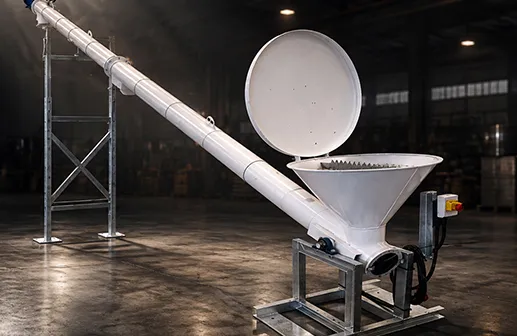
The Poggi Series 3BM manual bag discharger is equipped with a reinforced grid and an integrated bag-breaking blade. The bag is placed on the grid and the blade facilitates its opening, allowing the material to fall by gravity into the hopper below.
The steel structure is designed to withstand repeated use and the typical conditions found in production environments and construction sites. Its compact configuration also allows the system to be used where available space is limited.
What is a bag-breaking hopper used for?
The bag-breaking hopper performs two functions. Firstly, the grid and blade facilitate bag opening; secondly, the hopper temporarily collects the discharged material and connects it to the extraction system.
The product falls into the hopper by gravity and can then be extracted at a regular rate, avoiding the need to handle the material manually again.
This configuration makes the manual bag discharger particularly suitable when downstream processing stages need to be continuously fed with material supplied in bags.
How is the material transferred after bag emptying?
Once the bag has been opened, the material collected in the hopper must be transferred to the point of use.
In the Poggi Series 3BM manual bag discharger, this function is performed by an inclined screw conveyor. The material collected in the hopper is extracted by the screw conveyor and conveyed to the subsequent stages of the process, maintaining a regular flow at the outlet.
The system can therefore be used to feed other equipment or points of use, providing continuity between bag emptying and the subsequent handling of the material.
What materials can be handled?
Bag dischargers can be used with different types of powdered materials, provided that the characteristics of the product are compatible with the system configuration.
Applications for the Poggi manual bag discharger include cement, lime, premixed products and technical powders used in the construction industry and in various industrial processes.
The characteristics of the material must also be considered when selecting the extraction system. Flowability, particle size and powder behaviour can influence the regularity of discharge and subsequent transfer.
Manual bag discharger or big bag discharger?
The choice primarily depends on the format in which the material is supplied. A manual bag discharger is suitable for small bags that can be handled and opened directly by the operator.
When the material is supplied in large bags, a big bag discharger designed to handle this format and larger quantities of product is required.
The Poggi Series 3B Big Bag Discharger allows cement, lime, technical powders, granules and other bulk materials to be opened, contained and transferred in a controlled manner. The system can be integrated with screw conveyors, belt conveyors and weighing and dosing systems.
The choice between the two solutions therefore depends not only on the quantity of material used, but above all on the supply format and the requirements of the production process.
How to control dust when emptying big bags?
The discharge of particularly fine materials can generate dust during emptying operations. Depending on the application and the characteristics of the product, the big bag discharger can therefore be configured with dedicated filtration systems.
Among the options available for the Poggi Big Bag Discharger is a dust extraction filter, which can be used when operating conditions require greater control of the dust generated during discharge.
The need for this type of solution must be assessed according to the material being handled and the specific operating conditions.
How to choose the right bag emptying system?
To select the most suitable bag emptying system, the first factor to consider is how the material arrives at the point of use.
Bag size and weight, the quantity of product to be handled, operating frequency, material characteristics, available space and the downstream system to be fed are all factors that influence the configuration.
For small bags, a manual bag discharger for cement or other powders, equipped with a hopper and extraction screw conveyor, can provide a simple and compact solution. For materials supplied in big bags, a structure specifically designed for big bag emptying and the transfer of larger quantities of material is required.
Poggi S.p.A. develops both solutions, allowing the bag emptying and transfer system to be configured according to the material, packaging format and requirements of the production process.