Powder storage is an important stage in many industrial processes. Cement, lime, fly ash, bentonite, flour, premixed products, additives and other technical powders have very different characteristics and require storage solutions suited to the material and operating conditions.
Properly managing a powdered material does not simply mean containing it. It is also necessary to consider loading methods, the behaviour of the material inside the silo, air filtration, discharge and subsequent handling.
The choice of the most suitable solution therefore depends on the properties of the powder, the quantity to be stored, the continuity required by the process and the characteristics of the production site.
What is powder storage?
Powder storage refers to the controlled storage of solid materials consisting of small particles inside structures designed to keep them available for subsequent stages of use.
Powdered materials used in different industrial sectors can include:
- cement;
- lime;
- fly ash;
- bentonite;
- premixed products;
- flour;
- additives;
- fertilizers;
- carbonates;
- mineral powders;
- technical powders and other industrial materials.
Each material has different characteristics in terms of density, particle size, flowability, moisture, abrasiveness and tendency to compact.
For this reason, a system intended for storing a specific powder must be configured according to both the characteristics of the product and the process in which it will be used.
In the specific case of bentonite, its characteristics require appropriate handling before use. For more information on this material and its applications, see the article What is bentonite used for in construction?.
What problems can powdered materials present?
One of the most important aspects of powder handling is the behaviour of the material during storage.
Some materials flow easily, while others may compact or form accumulations that make discharge more difficult.
The main aspects to consider include:
- formation of bridges or material build-up;
- difficulty in flowing towards the discharge point;
- material compaction;
- presence and dispersion of dust during loading;
- changes in material characteristics caused by moisture;
- the need to maintain a constant flow rate during extraction.
The configuration of the storage system must therefore take into account not only the quantity of material to be contained, but also how the material will enter and leave the silo.
The role of silos in powder storage
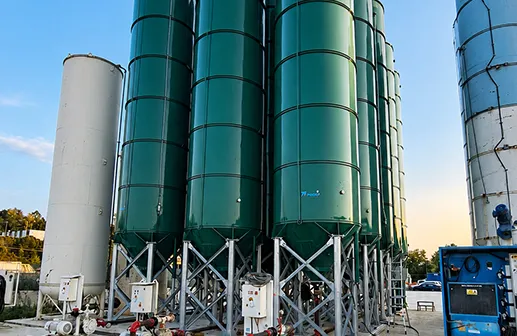
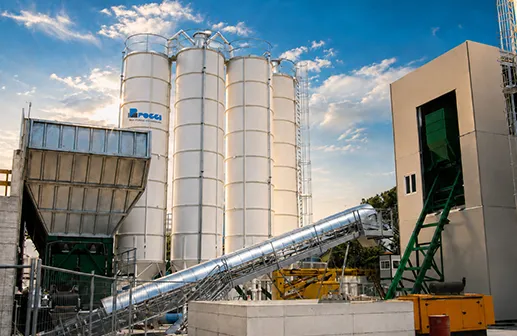
Industrial silos are among the most widely used solutions for storing bulk materials in powder form. Poggi itself identifies materials such as cement, lime, fly ash and premixed products among the typical applications for its monolithic vertical silos.
The material is loaded into the silo and then made available for subsequent processing stages through extraction and handling systems.
Different configurations can be used depending on operating requirements.
Monolithic vertical silos are designed for storing bulk materials in powder form such as cement, lime, fly ash and premixed products.
When larger storage capacities are required, bolted vertical silos can be used. Their modular construction makes them particularly suitable for medium to large storage applications and facilitates transport.
For projects where transport and logistics are particularly important, telescopic vertical silos are also available. They are designed to reduce transport dimensions while maintaining rapid on-site assembly.
Finally, horizontal silos can be used where mobility, rapid installation or specific space requirements are important. Poggi describes them as suitable for storing powders, ash and granular materials.
How are powders loaded?
Material can be introduced into a silo using different loading systems.
For industrial powders, pneumatic conveying is frequently used to transfer the material through pipes into the silo.
During this stage, the air used to convey the product must be discharged while limiting the dispersion of material into the surrounding environment.
For this reason, powder storage systems can be equipped with filters designed to retain particles carried by the air during loading.
Correct management of internal pressure is also an important aspect of pneumatic loading operations.
Filtration and dust control
Filtration plays an important role in the storage of powdered materials.
During pneumatic loading, the air introduced into the silo must be able to escape while the material remains inside the structure.
Filtration systems retain particles carried by the air, helping to limit dust dispersion in the working area.
The configuration can also include devices for pressure control and for managing loading operations.
These components must be sized and configured according to the characteristics of the material, the loading method and the operating conditions.
How are powders discharged from a silo?
Discharge is one of the most important stages in the handling of powdered materials.
In vertical silos, the material is generally directed towards the lower part of the structure through a discharge cone.
From there, it can be transferred to subsequent processing stages using different systems, including:
- screw conveyors;
- valves;
- pneumatic conveying;
- dosing systems;
- other material handling solutions.
The configuration mainly depends on the characteristics of the powder and the required flow rate.
For a more detailed explanation of extraction systems, see How is a silo emptied?. The choice of extraction system can vary significantly according to the material being handled, as powders such as cement, lime and fly ash behave differently from flour, pellets, biomass or fertilizers.
Powder fluidization and vibration
Some powders may have difficulty flowing during discharge.
In these cases, systems can be used to encourage the movement of the material towards the extraction point.
Fluidization uses compressed air introduced into the lower area of the silo to help powdered or lightweight materials flow more easily.
In other applications, vibration systems can be used to reduce build-up and facilitate emptying. Poggi also uses vibration systems in its bulk-material handling solutions to help prevent bridge formation and maintain a regular material flow.
The choice always depends on the specific behaviour of the material.
Powder storage and handling
Storage cannot be considered separately from material handling.
Once extracted from the silo, the powder must be transferred to subsequent stages of the production process.
Screw conveyors, pneumatic systems and other conveying devices can create a continuous flow between the storage point and the point of use.
When material is supplied in big bags, big bag dischargers can be used to empty the material and transfer it to conveying or dosing systems, or directly towards a silo. Poggi’s big bag dischargers are designed for materials including cement, lime, technical powders and granules.
The aim is to create coordinated material management from receipt through to its final use.
How to choose a powder storage system
The choice of a solution for industrial powder storage should begin with an analysis of the material.
The main parameters to consider include:
- type of powder;
- density;
- particle size;
- flowability;
- moisture;
- abrasiveness;
- quantity to be stored;
- loading method;
- required discharge flow rate;
- available space;
- weighing or dosing requirements;
- characteristics of the production process.
There is therefore no single configuration suitable for every application.
A properly designed system must combine storage capacity, silo geometry and loading, filtration and extraction systems according to the material being handled.
Poggi solutions for powder storage
Poggi designs and manufactures solutions for the storage and handling of bulk materials, including powders used in many industrial sectors.
The range includes monolithic vertical silos, bolted silos, telescopic silos, horizontal silos and solutions for material handling and management.
For applications where powder needs to be transferred directly through pneumatic systems, pneumatic horizontal silos are also available. These are designed as pneumatic transport silos and can be used in applications where mobility and pneumatic transfer are required.
Each configuration is defined according to the characteristics of the material, the required capacity, the available layout and the operating requirements.
Correct powder management therefore helps create continuity between storage, extraction, dosing and handling, keeping the material available in a controlled way throughout the different stages of the process.