Aggregates are a fundamental component of concrete. Sand, gravel, crushed stone and other granular materials form the structure of the mixture and help determine its strength, stability, workability and durability.
However, the quality of concrete does not depend solely on the type of cement used. The origin of the aggregates, their particle-size distribution, moisture content, material cleanliness and dosing accuracy also influence the final result.
For this reason, in concrete batching plants, aggregate handling and storage must be organised so that the different particle sizes remain separated and continuously feed the subsequent weighing and mixing stages.
What are aggregates?
The term aggregates refers to granular materials of mineral origin used in construction and concrete production. They are also sometimes referred to as inert materials.
When searching for the meaning of the term “aggregate”, it refers to a material such as sand, gravel or crushed stone that, once incorporated into the mixture, is bound together by the paste formed by cement and water.
The most commonly used aggregates include:
- sand;
- gravel;
- crushed stone;
- fine gravel;
- crushed aggregates;
- recycled aggregates;
- lightweight aggregates.
Aggregate materials may come directly from natural deposits, aggregate quarries or the crushing and selection of rocks.
They may also be obtained through the recovery and processing of materials generated by construction and demolition activities.
The expression “inert substances” is sometimes used in a general sense, but in concrete production it is more appropriate to refer to aggregates for concrete.
What aggregates are used in concrete?
Aggregates for concrete are mainly classified according to the size of their particles.
Fine aggregates consist primarily of sand and other materials with a small particle size. Their function is to fill part of the spaces between larger aggregates and contribute to the workability of the mixture.
Coarse aggregates include gravel, crushed stone and larger fragmented materials. These components form the load-bearing skeleton of the concrete and contribute to the stability of the product once it has hardened.
Depending on their origin, aggregates may be:
- natural, when they come from alluvial deposits or rock processing;
- crushed, when they are produced using crushers and subsequently classified;
- recycled, when they come from the controlled recovery of construction materials;
- lightweight, when they are used to produce concrete with a lower density.
The choice of aggregate depends on the type of concrete to be produced, the required performance and the final application of the structure.
What are aggregates used for in concrete?
In concrete, the paste formed by cement and water surrounds and binds the aggregates, transforming the different components into a compact mass.
Aggregates are therefore not simply filling materials. They perform several fundamental functions.
They form the structure of the mixture
Aggregates account for most of the volume of concrete. The combination of sand, gravel and crushed stone creates a granular structure that is consolidated by the cement paste.
A balanced distribution of different particle sizes reduces the empty spaces between particles and produces a more compact mixture.
They contribute to strength
The characteristics of the aggregates influence the mechanical performance of concrete.
The strength of the rock, the shape of the particles, their surface texture and their bond with the cement paste can affect how the material behaves when subjected to loads.
Increasing the amount of cement is therefore not enough to obtain high-quality concrete. The quality of the aggregates must also be suitable for the required performance.
They limit concrete shrinkage
During setting, hardening and drying, the cement paste may undergo dimensional changes.
Aggregates help limit these deformations and maintain greater stability in the overall volume of the concrete.
An unbalanced composition may instead contribute to shrinkage, cracking and inconsistent final performance.
They influence workability
The shape and particle-size distribution of aggregates influence how easily the concrete can be mixed, transported, pumped and placed.
Rounded aggregates generally promote easier flow of the mixture, while crushed stone and fragmented aggregates, characterised by more irregular surfaces, may require different adjustments to the quantities of water, cement and admixtures.
They reduce the amount of cement paste required
A correct combination of fine and coarse aggregates allows the spaces within the mixture to be filled more effectively.
This makes it possible to reduce the amount of cement paste required to bind the components while maintaining the performance specified in the concrete mix design.
Why is aggregate particle-size distribution important?
Particle-size distribution describes the range and distribution of particle sizes that make up an aggregate.
In a correctly designed mixture, smaller particles occupy part of the spaces left by larger particles. The result is a more compact, consistent and stable structure.
An unsuitable particle-size distribution may cause:
- an excessive amount of voids;
- a greater requirement for cement paste;
- difficulties during mixing;
- segregation of the components;
- variations in workability;
- inconsistent concrete performance.
To maintain the specified composition, the different particle sizes must remain separated during aggregate supply, storage and dosing.
How are aggregates processed?
Aggregate processing includes all the operations through which extracted or recovered material is transformed into aggregates suitable for use in the construction sector.
The process may include:
- quarry extraction;
- material reception and feeding;
- crushing;
- screening;
- washing;
- removal of impurities;
- particle-size classification;
- storage of the different particle sizes;
- loading and distribution.
In aggregate processing plants, crushers and screens reduce and classify the material, while primary hoppers receive sand, gravel, crushed stone and other aggregates at the beginning of the production line.
The material is then moved between the different processing stages using conveyor belts for aggregates, sized according to particle size, required capacity and product characteristics.
Why is aggregate storage important?
Aggregate storage performs two main functions: ensuring that sufficient material is available to feed production and keeping the different types of aggregates separated.
Incorrect management may cause contamination, mixing of different particle sizes, moisture variations and differences in the actual quantity of material incorporated into the mixture.
A correctly designed storage system makes it possible to:
- keep sand, gravel and crushed stone separated;
- reduce contamination by soil or other foreign materials;
- control moisture content more effectively;
- limit particle segregation;
- maintain reserves suited to consumption requirements;
- feed dosing systems consistently;
- reduce unnecessary material handling;
- ensure continuity in concrete production.
Moisture must be monitored particularly carefully in sand and fine aggregates.
A variation in the amount of water contained in the material may alter the total quantity of water introduced into the mixture and require an adjustment to the mix design.
Hoppers for aggregates and inert materials
Sand, gravel and crushed stone are generally stored in separate hoppers or compartments so that the different particle sizes remain separated until dosing takes place.
Hoppers for aggregates and inert materials can be used during the material reception, accumulation, weighing and extraction stages.
Inline hoppers make it possible to organise several adjoining compartments and provide controlled feeding to conveyor belts, weighing systems and mixers.
Capacity, wall geometry, bottom inclination and discharge-opening dimensions must be defined according to the particle size, moisture, density and abrasiveness of the material.
What is the role of silos?
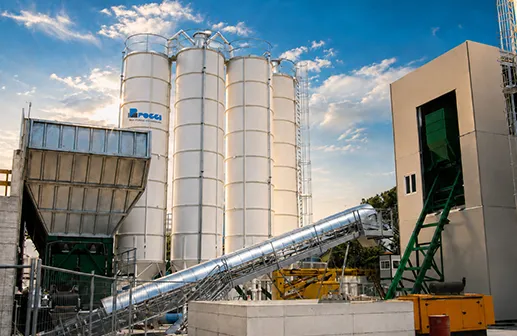
In concrete production plants, silos are mainly used to store cement, lime, fillers, fly ash and other fine or powdered materials.
These materials must be protected from moisture and stored separately to ensure continuity and accuracy during dosing.
Depending on the characteristics of the product and the production process, vertical silos can also be configured for specific granular or mineral materials compatible with this storage method.
When high capacities, modular construction and optimised transport logistics are required, bolted vertical silos may be used. They are designed according to the characteristics of the material, the required capacity and the operating conditions.
The choice between a silo, a hopper or a multi-compartment system should therefore not depend solely on the volume to be stored, but also on the behaviour of the material during loading, storage and discharge.
Aggregate management in concrete batching plants
In a concrete batching plant, aggregates are generally stored in separate hoppers, extracted and transferred to the weighing system using conveyor belts.
Cement and other powdered materials are instead stored in dedicated silos and transferred to the dosing system through extraction and conveying devices.
During the production cycle, predetermined quantities of the following components are dosed:
- fine aggregates;
- coarse aggregates;
- cement;
- water;
- admixtures;
- any additional components.
Hoppers, conveyor belts and silos must therefore operate in a coordinated manner.
Consistent material flow and accurate dosing help maintain a uniform concrete composition and reduce material waste.
How to choose a storage system for aggregate management
The configuration of an aggregate processing plant must begin with an analysis of the material characteristics and operating conditions.
The main aspects to assess include:
- the type and origin of the aggregate;
- minimum and maximum particle size;
- bulk density;
- moisture content;
- abrasiveness;
- tendency to segregate;
- required storage capacity;
- required flow rate;
- loading method;
- dosing accuracy;
- the number of materials that must remain separated;
- available space.
A fine, moist material may behave very differently from dry, large-sized crushed stone.
The storage structure and extraction system must therefore be defined according to the actual behaviour of the product.
Poggi solutions for aggregate storage and handling
Poggi designs and manufactures products and solutions for the storage and handling of bulk materials used in the construction, mining and concrete sectors.
The range includes primary hoppers, inline hoppers, conveyor belts and silos that can be configured according to the characteristics of the aggregates and the requirements of the production line.
Hoppers make it possible to receive, separate, accumulate and dose sand, gravel, crushed stone and other aggregate materials.
Conveyor belts connect the loading, processing, storage and mixing stages.
Silos allow cement, powders, minerals and compatible granular materials to be stored under controlled conditions.
Discover the solutions for the construction and mining sectors developed by Poggi for bulk material handling.
Conclusions
Aggregates are essential in concrete production because they form its granular structure and help determine its workability, strength, stability and durability.
To achieve consistent performance, selecting high-quality aggregates is not enough. They must also be kept separated, their moisture content must be controlled, they must be protected from contamination and they must be dosed accurately.
Hoppers, conveyor belts and silos perform different but complementary functions.
A solution designed according to the actual characteristics of the materials improves production continuity, reduces waste and increases the efficiency of the entire aggregate management process for concrete.