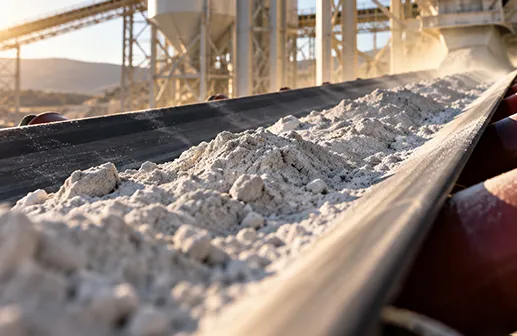
Bentonite is a natural clay used in many construction applications because of its ability to absorb water, expand in volume and form suspensions with high viscosity and low permeability.
In the construction sector, bentonite is mainly used for waterproofing, deep foundations, diaphragm walls, drilling, geotechnical works and underground construction. In many of these applications, it is delivered as a bulk material, in powder or granular form, and stored in silos before the suspension is prepared.
What is bentonite?
Bentonite is a clay-rich rock generally formed through the alteration of volcanic materials. It mainly consists of minerals belonging to the smectite group, including montmorillonite.
When it comes into contact with water, its structure hydrates and, in some types, expands considerably in volume. This property makes it possible to obtain viscous suspensions, gels and mixtures with very low permeability.
The main types are:
- sodium bentonite, characterised by a high swelling capacity;
- calcium bentonite, generally less expansive and mainly used for its absorbent properties;
- activated bentonite, treated to modify its performance for specific applications.
The choice between sodium, calcium and activated bentonite depends on the required result, soil characteristics, the presence of water and the parameters established by the project.
What is bentonite used for in construction?
Bentonite is mainly used in construction to prepare mixtures and suspensions designed to control water, stabilise excavations and create low-permeability barriers.
Its main applications include waterproofing, diaphragm walls, deep foundations, drilling, geotechnical works and underground construction.
Bentonite for waterproofing
One of its best-known applications is bentonite waterproofing.
Sodium bentonite can be incorporated into panels, mats, membranes and composite systems used to protect:
- foundations;
- retaining walls;
- foundation slabs;
- underground car parks;
- tanks;
- tunnels;
- concrete structures in contact with the ground.
When the clay comes into contact with water, it expands and helps create a low-permeability layer. This allows the material to adapt to surfaces and limit the passage of water through the waterproofing system.
Diaphragm walls and impermeable barriers
Bentonite is used in the construction of plastic diaphragm walls and slurry walls, which are underground walls built to support excavations or limit groundwater movement.
During excavation, a water-bentonite suspension helps stabilise the walls of the trench. The space can then be filled with concrete, cement-bentonite mixtures or soil mixed with bentonite.
These systems are used in:
- infrastructure projects;
- deep excavations;
- underground rail systems;
- underground car parks;
- groundwater containment;
- site remediation;
- barriers against contaminant migration.
Soil-bentonite and cement-bentonite walls are used as underground barriers because they combine excavation stability with low permeability in the completed structure.
Piles and deep foundations
In bored pile and deep foundation construction, bentonite slurries can temporarily support the walls of the borehole before reinforcement is inserted and concrete is poured.
The suspension helps reduce the risk of wall collapse, particularly in loose soils or in the presence of groundwater.
To obtain a suspension with consistent properties, the quantity of bentonite, the water-to-bentonite ratio, mixing times and any additives must be controlled. Variations in powder feed can alter the density and viscosity of the prepared slurry.
Tunnelling and underground works
Bentonite is also used in tunnelling and other underground construction activities.
It can be used to prepare support fluids, control pressure at the excavation face and facilitate the management of excavated material. In certain configurations, bentonite powder is extracted from storage, dosed and fed into a water-mixing system.
In these projects, continuity of supply is particularly important. An interruption in material availability can slow slurry preparation and, consequently, the excavation operations that depend on it.
Why is correct bentonite storage so important?
Bentonite is selected precisely because of its ability to react with water. This property is essential during use, but it must remain controlled before mixing.
If the powder comes into premature contact with moisture or water infiltration, it can lose part of its flowability, form aggregates and become more difficult to extract and dose. The issue therefore affects not only product preservation, but also the continuity of the entire process.
A properly configured storage system helps to:
- protect bentonite from weather and moisture;
- reduce lump formation and material build-up;
- maintain a reserve suited to operational requirements;
- feed dosing and mixing equipment continuously;
- contain dust emissions during filling;
- monitor the quantities received and used;
- reduce the manual handling of bags or big bags;
- improve site or plant logistics.
Correct storage therefore helps preserve the material’s characteristics and makes the operations preceding slurry preparation more consistent.
From bentonite powder to slurry: the role of the silo
When bentonite is used in significant quantities, it is not managed merely as a product to be stored. It becomes part of a process that includes receiving, storage, extraction, dosing and mixing.
The silo is therefore the connection point between the delivery of bulk bentonite and the preparation of the slurry required by the construction site or production line.
Its role is not simply to accumulate material, but to make it available in the quantity and at the time required by the process.
Receiving and filling bentonite
When bentonite is delivered in bulk by tanker, the silo can be filled pneumatically.
The airflow used to convey the powder must be managed correctly during filling. The silo can therefore be equipped with a dust filter, a pressure relief valve and level indicators.
The filter allows air to escape while retaining the particles carried by the airflow. The pressure relief valve protects the structure from abnormal pressure or vacuum conditions, while the level indicators help monitor the amount of material inside.
Poggi vertical silos can be equipped with filters, pressure relief valves, level indicators and fluidisation systems configured according to the material and operating conditions.
Protection from water and moisture
Bentonite’s ability to interact with water is essential during use, but it must remain controlled during storage.
Before slurry preparation, bentonite powder must be protected from precipitation and accidental water ingress. Premature and uneven contact with moisture can promote aggregate formation and alter material flowability.
The sealing of the silo, the filling system, the filter and the connections to downstream equipment must therefore be designed to maintain the product in the required condition until it is used.
Promoting consistent discharge
Bentonite is a fine powder, and its discharge behaviour can vary according to particle size, bulk density, moisture content and degree of compaction.
For this reason, selecting a silo based only on nominal capacity is not sufficient. The lower-section geometry, outlet size and extraction system must also be considered.
If the product tends to compact or create stagnant areas, fluidisation or vibration systems can be used. Their function is to promote the movement of bentonite towards the outlet, reducing the risk of bridges or material build-up along the walls.
The configuration must be defined according to the actual characteristics of the bentonite, because products with similar names can behave differently during storage and discharge.
Extracting only the required quantity
Once it reaches the discharge outlet, bentonite must be transferred to the dosing unit, weighing system or mixer.
Extraction can be carried out using a screw conveyor sized according to the required flow rate and the characteristics of the powder. The screw speed and drive system make it possible to regulate the amount of material transferred.
This stage is important because the process does not simply require the silo to be emptied. It requires the downstream system to be fed continuously and in a controlled way.
A flow that is too high, irregular or subject to interruptions can make it more difficult to maintain a constant water-to-bentonite ratio.
Dosing and mixture preparation
In more structured applications, the bentonite extracted from the silo can be sent to a weighing system before reaching the mixer.
Weighing makes it possible to verify the quantity introduced into each cycle and improve the repeatability of the slurry properties. The control system can be integrated into the overall process, coordinating extraction, weighing, water loading and mixing.
Poggi also manufactures Powder Blenders that combine weighing and mixing and can be connected to silos, hoppers and powder conveying systems. The available configuration includes load cells, multiple inlets and controlled discharge towards the subsequent process stages.
The most suitable system depends on the type of bentonite, the formulation to be prepared, the required output and the organisation of the construction site.
How should bentonite storage capacity be sized?
Silo capacity should not be selected solely according to the maximum quantity it can contain.
Correct sizing requires an assessment of:
- daily bentonite consumption;
- material bulk density;
- delivery frequency;
- tanker capacity;
- required operating autonomy;
- available space;
- mixture preparation rate;
- the possible need for a safety stock.
An undersized silo requires more frequent deliveries and may expose the process to the risk of running out of material. Excessive capacity, on the other hand, can take up unnecessary space and increase the time the powder remains inside the container.
Correct sizing therefore results from analysing the entire logistics and production cycle, rather than considering silo volume in isolation.
Which silo configuration is suitable for bentonite?
There is no single configuration suitable for every use of bentonite in construction.
For a fixed installation with continuous consumption and sufficient vertical space, a monolithic vertical silo can be considered. The structure is transported as a single unit and can be equipped with the devices required for filling, level control, filtration and extraction.
For large capacities or plants that require substantial reserves, a bolted silo can be considered. Its modular structure makes it possible to achieve high volumes and adapt diameter and height to the project conditions.
When transport optimisation is important, particularly for international projects, telescopic silos reduce overall dimensions during shipment. Poggi TC and TP series use sliding sections and are respectively optimised for transport in open-top containers or by truck.
For temporary or frequently relocated construction sites, a horizontal silo can be considered. Poggi OR and ORC series can be installed without permanent foundations, are equipped with telescopic legs and can incorporate a swivelling screw conveyor to transfer material to downstream equipment.
The final choice must start from the characteristics of the bentonite and the way it will be used, considering storage, transport, extraction and dosing together.
Why consider the complete process rather than the silo alone?
Effective bentonite management depends on coordination between all process stages.
A correctly sized silo connected to an unsuitable extraction system can still produce irregular feeding. Likewise, a correctly sized screw conveyor cannot ensure continuity if the material does not flow evenly towards the discharge outlet.
Designing an effective solution therefore requires an analysis of:
- bentonite delivery method;
- physical characteristics of the product;
- environmental conditions;
- required autonomy;
- extraction method;
- distance from the point of use;
- dosing accuracy;
- mixer capacity;
- frequency of preparation cycles.
This approach makes it possible to consider the silo as an integral part of the process rather than as an independent container.
Bentonite storage and handling with Poggi
Bentonite plays an important role in many construction applications, from waterproofing and deep foundations to diaphragm walls, drilling and underground works.
Before hydration, it must be stored under suitable conditions and made continuously available. The storage system must therefore protect the material, promote consistent discharge and feed the subsequent dosing and mixing stages in a controlled way.
Poggi designs and manufactures silos and solutions for storing and handling bulk powder and granular materials. Depending on project requirements, the configuration can include filtration, level control, fluidisation, extraction, weighing and connection to downstream equipment.