Conveyor belts are used to move bulk materials continuously between different stages of a production process. However, there is no single configuration suitable for every application.
The correct conveyor belt must be selected according to the route followed by the material, the difference in height between loading and discharge points, the required capacity, the available space and the characteristics of the product being handled.
The main industrial conveyor belt configurations include:
- horizontal conveyor belts;
- inclined conveyor belts;
- slewing conveyor belts;
- extractor conveyor belts;
- shuttle conveyor belts;
- mobile conveyor belts;
- weighing conveyor belts.
Each solution can also be customised in terms of structure, belt material, dimensions, accessories and control systems.
How Are Conveyor Belts Classified?
Industrial conveyor belts can be classified according to several criteria. The main ones are:
- the direction and layout of the route;
- the function performed within the production line;
- the possibility of moving the discharge point;
- the use of a fixed or mobile structure;
- the type of belt material;
- the presence of weighing and control systems.
A horizontal conveyor and an inclined conveyor are distinguished by the route followed by the material. Extractor and weighing conveyors, on the other hand, are mainly classified according to the function they perform.
Horizontal Conveyor Belts
Horizontal conveyor belts move material along a mainly level route. They are used to connect two or more consecutive production stages, transfer materials between different operating areas or feed hoppers, silos and dosing systems.
This configuration is suitable when the loading and discharge points are positioned at similar heights and the material does not need to be lifted.
A horizontal conveyor belt can be installed on a fixed structure or mounted on a mobile frame. Its length, belt width and capacity are defined according to the plant layout and the characteristics of the material.
Inclined Conveyor Belts
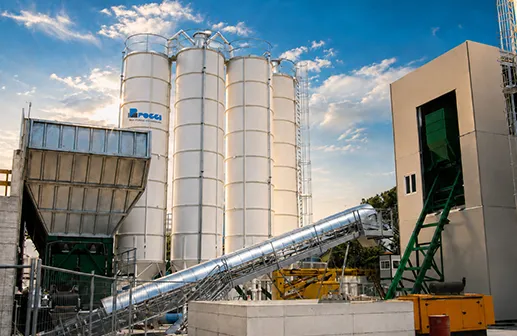
Inclined conveyor belts transfer materials between points located at different heights. They can be used to feed an elevated hopper, reach a loading point or move material towards a subsequent processing stage positioned at a higher level.
The angle of inclination must be evaluated according to the characteristics of the product. Particle size, moisture, bulk density and flowability influence the stability of the material during transport.
When required, the belt can be equipped with cleats, profiles or containment systems to prevent the material from sliding backwards.
Slewing Conveyor Belts
Slewing conveyor belts can change the position of the discharge point through horizontal rotation.
This configuration makes it possible to distribute material over a larger area or feed different destinations without installing several separate conveyor lines.
A slewing conveyor belt can be used to:
- create material stockpiles;
- fill storage areas or pits;
- distribute material between different hoppers;
- change the position of the discharge point;
- optimise the available space.
Extractor Conveyor Belts
Extractor conveyor belts are installed underneath silos, hoppers or other storage containers to withdraw material and transfer it to the next stage of the process.
Their function is not limited to transportation. They must also ensure continuous and controlled extraction, preventing excessive variations in the material flow.
A conveyor belt with hopper can be sized according to the capacity of the container, the required output and the feeding system installed downstream.
Speed regulation makes it possible to adapt the material flow to the requirements of the production line. The extractor conveyor can also be integrated with load cells or other measuring devices.
Shuttle Conveyor Belts
Shuttle conveyor belts move horizontally along dedicated rails and distribute material to multiple loading or discharge points.
They are particularly useful when a single conveyor line must feed several containers, hoppers or compartments. The movement of the conveyor changes the destination of the material without requiring several separate conveying systems.
This configuration can be used when the process requires:
- distribution to multiple hoppers;
- feeding of different compartments;
- flexible management of discharge points;
- optimisation of the available space.
Mobile Conveyor Belts
A mobile conveyor belt is installed on a structure that allows it to be repositioned within the operating area.
It is selected when the loading or discharge point can change, or when the same conveyor must be used in several operating areas.
Mobility can be provided by wheels, dedicated frames or other systems designed according to the size of the conveyor and its operating conditions. Stability, accessibility, safety and feeding methods must all be carefully evaluated.
Weighing Conveyor Belts
Weighing conveyor belts include systems that continuously measure the amount of material being transported.
Load cells detect the weight, while the control system combines this information with the belt speed. This makes it possible to calculate the material flow rate during operation.
The collected data can be displayed, recorded or transmitted to the production line supervision system. A weighing conveyor is useful when the process requires quantity control, traceability or flow regulation.
Rubber Conveyor Belts
Rubber conveyor belts are widely used for handling bulk materials because of their versatility and resistance.
The term “rubber conveyor belt” normally refers to the flexible belt that runs over rollers and carries the material. The compound, thickness and surface characteristics must be selected according to:
- particle size;
- weight and bulk density;
- abrasiveness;
- moisture content;
- operating temperature;
- route inclination;
- environmental conditions.
The terms belt conveyor and conveyor belt system are sometimes used interchangeably. In an industrial conveyor, however, the belt is only one of the system components, together with the frame, rollers, drums, tensioning system and safety devices.
Conveyor Belts for Aggregates and Sand
An aggregate conveyor belt is used to handle materials such as sand, gravel, crushed stone and other aggregates used in construction, concrete production and mineral processing.
These materials may be heavy, abrasive, wet or characterised by different particle sizes. The design must therefore consider structural strength, required capacity, belt width, operating speed and component protection.
A sand conveyor belt may require sidewalls, covers, scrapers and collection systems to reduce material spillage and deposits along the route.
The conveyor belt can be combined with receiving hoppers, weighing systems, silos and other solutions for storing and handling bulk materials.
Conveyor Belts for Pellets, Biomass and Wood Residues
A conveyor belt for pellets and biomass must be configured according to the weight, shape and flowability of the material.
Pellets, wood chips, sawdust and wood processing residues can have different densities and dimensions. The system must therefore take into account side containment, belt speed, feeding continuity and protection from dust or weather conditions.
When handling processing residues, the design should also prevent material build-up and facilitate inspection and cleaning operations.
What Is the Difference Between a Belt Conveyor and a Roller Conveyor?
A belt conveyor uses a continuous surface on which the material is placed. A roller conveyor, on the other hand, mainly transports boxes, pallets or products with a stable supporting surface through a series of rollers.
For sand, gravel, pellets, granules and other bulk materials, a belt conveyor is generally used because its continuous surface contains and carries the product along the entire route.
The expression roller belt conveyor can therefore be misleading when comparing the two technologies. A conveyor belt may run over support rollers, but the system remains a belt conveyor.
How Do You Choose the Right Conveyor Belt?
The selection should not be based only on the length of the route. Before designing the conveyor system, the following factors must be evaluated:
- type and particle size of the material;
- bulk density;
- moisture, abrasiveness and flowability;
- required hourly capacity;
- distance to be covered;
- initial and final height;
- number of loading and discharge points;
- available space;
- continuous or intermittent operation;
- environmental and weather conditions;
- weighing or dosing requirements;
- integration with hoppers, silos and control systems.
The same type of conveyor can be configured in very different ways. Two inclined conveyor belts, for example, may have different widths, structures, belt surfaces, angles and accessories depending on the material and required capacity.
Why Are Conveyor Belts Custom-Made?
Custom conveyor belts make it possible to adapt the system to the available layout and the actual requirements of the production process.
Customisation may include:
- length and inclination;
- belt width and characteristics;
- discharge height;
- fixed or mobile structure;
- sidewalls and protective guards;
- covers against dust and weather conditions;
- scrapers and cleaning systems;
- speed control;
- weighing systems;
- sensors and safety devices;
- connection to electrical panels and PLC systems.
A correctly designed system allows the conveyor belt to be integrated with the other stages of material reception, storage, dosing and transfer.
Poggi Conveyor Belt Configurations
Poggi designs and manufactures NT Series conveyor belts for handling bulk materials. Each solution is configured according to the characteristics of the product and the customer’s operating requirements.
The available solutions include horizontal, inclined, slewing, extractor and shuttle conveyor belts, as well as mobile configurations and continuous weighing systems.
Length, belt width, inclination, discharge height, structure, protective systems and accessories can be defined according to the specific project.
For further technical information and available configurations, visit the page dedicated to Poggi industrial conveyor belts.