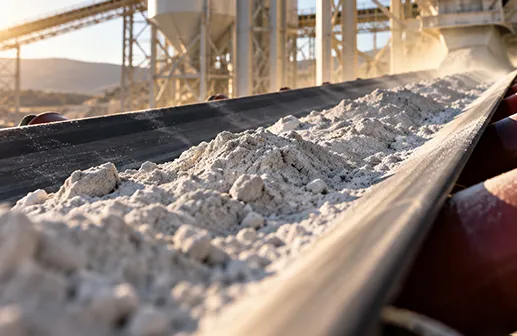
The belt conveyor or conveyor belt is a fundamental solution for the continuous handling of materials within production lines, storage areas, dosing systems and processing operations. Its function is to transfer materials from one point to another in a regular, safe and controlled manner, reducing handling times and improving operational continuity.
When dealing with bulk materials, such as sand, gravel, aggregates, premixed materials, granules, cereals, powders, biomass or industrial by-products, the belt conveyor plays an even more important role. It is not simply a matter of moving material, but of ensuring a constant flow between the different stages of the process, avoiding interruptions, material dispersion and unnecessary manual operations.
For this reason, an industrial belt conveyor should not be considered a simple standard component. The choice of the most suitable solution depends on the type of material, the required capacity, the distance to be covered, the inclination, the loading and discharge points, the available space and the desired level of automation.
What is an industrial belt conveyor used for?
A belt conveyor is used to move materials along a defined route, continuously connecting different stages of a process. It can be used to feed a hopper, load a silo, transfer material to a weighing or dosing system, or distribute the product to several discharge points. Belt conveying is particularly suitable when a continuous flow of bulk materials must be maintained between storage, dosing and processing operations.
In industrial applications, belt conveyors improve material management by maintaining a stable flow, reducing manual intervention and creating a more orderly connection between the different operating areas.
Their main functions include:
- transporting bulk materials along horizontal or inclined routes;
- feeding silos, hoppers, dosing systems or mixing systems;
- controlled extraction of material from storage containers;
- distributing material to several loading or discharge points;
- reducing handling times;
- improving operator safety;
- improving the continuity of the production process.
Belt conveyors for bulk materials: where are they used?
Belt conveyors for bulk materials are used in a wide range of industries. Their structure, belt, accessories and control systems can be adapted to the nature of the material and the customer’s operational requirements.
Industrial construction, concrete production and premixed materials
In the concrete production, industrial construction and premixed materials sectors, belt conveyors are used to handle cement, lime, sand, gravel, aggregates and other materials intended for storage, transfer or dosing operations. These applications require robust structures, resistant components and solutions capable of operating continuously, even in dusty environments or under heavy loads. In this context, they are often referred to as belt conveyors for the construction industry. Belt conveyors play a particularly important role in this sector.
Chemical, environmental and agricultural industries
In the chemical, environmental and agricultural sectors, belt conveyors can be used to handle powders, reagents, granular products, fertilisers, biomass and organic materials. The choice of belt, rollers, guards and accessories must take into account the physical characteristics of the product and the conditions of the working environment.
Environmental recovery and recycling
In environmental recovery and recycling operations, the materials being handled may be abrasive, irregular or derived from industrial by-products. In these cases, the belt conveyor must ensure resistance, reliability and ease of maintenance. Belt cleaning systems, side guards, protective covers and accessible components help maintain the efficiency of the solution over time.
Food processing and animal feed
In the food processing and animal feed sectors, belt conveyors can be used for flour, cereals, additives and powdered or granular products. The configuration must be designed according to the particle size of the material, the required capacity and the requirements for control, cleaning and flow continuity.
Plastics, rubber, wood and biomass
In the plastics and rubber industries, belt conveyors are used to handle polymers, granules and technical compounds. In wood processing and biomass applications, they can be used for sawdust, pellets and alternative materials, with customised configurations based on the available space, the distances to be covered and the discharge points.
In the biomass sector, a biomass belt conveyor must be designed according to the characteristics of the material being handled, which may be lightweight, irregular, moist or subject to variations in volume. Sawdust, pellets, wood chips and processing residues require robust and continuous solutions configured according to the required capacity, transport distance and discharge point. In these cases, the choice of belt, side guards and cleaning accessories is essential to ensure a regular flow and reduce material accumulation or dispersion along the route.
What are the different types of belt conveyors?
The configuration of a belt conveyor depends on the route the material must follow, the starting and arrival heights, the need to distribute the product to several points and the type of feeding required.
To learn more about the main available configurations, their characteristics and their different fields of application, read our dedicated guide: What are the different types of belt conveyors?
What is an industrial belt conveyor made of?
An industrial belt conveyor consists of several mechanical and structural components that work together to ensure continuous movement, stability and safety. Its configuration may vary according to the material being handled, the required capacity and the operating environment.
The main components include:
- steel truss structure, designed to ensure structural strength and durability;
- support structure, configurable according to the installation environment;
- protective cover, used to protect the material and the system under specific operating conditions;
- drive pulley, which moves the belt forward;
- belt, available in different compounds and thicknesses according to the particle size and characteristics of the material;
- support rollers, which support and guide the belt during operation;
- scraper, designed to remove material residues and reduce system wear.
Each component must be carefully selected and sized. Abrasive, dusty, moist or irregular materials require specific technical solutions to ensure long-term reliability and simplify maintenance operations.
The advantages of Poggi NT Series belt conveyors
Poggi NT Series belt conveyors are designed for the continuous, safe and efficient handling of bulk materials. Their modular and customisable structure allows each solution to be adapted to the customer’s layout, optimising the connection between the different loading, discharge and dosing stages.
The main advantages include:
- customisable lengths and inclinations according to the layout;
- high and adjustable handling capacities according to operational requirements;
- rapid assembly and easier maintenance thanks to accessible components;
- compatibility with hoppers, screw conveyors, weighing systems and dosing systems;
- safety ensured by side guards, protective covers, sensors and emergency stop devices;
- dimensions, structure and accessories configurable on request;
- integration with automation and control systems.
Customisation may involve the conveyor length, belt width, discharge height, accessories, protective devices, adjustment systems and operating interfaces. This makes it possible to obtain a product that is consistent with the characteristics of the material and the organisation of the production line.
Automation, weighing and material control
A modern belt conveyor does not perform only a mechanical transfer function. It can become part of a material control system through integration with weighing devices, sensors, inverters, electrical control panels and PLC-compatible interfaces.
Poggi belt conveyors can be equipped with continuous weighing systems designed to measure the quantity of material being transported during operation. Load cells measure the weight in real time, while the electronic system calculates the flow rate according to the belt speed.
The data can be displayed on digital terminals, recorded to ensure traceability of production cycles and integrated into supervision systems. In this way, the conveyor contributes not only to material handling, but also to process control and the management of operational performance.
Accessories and optional equipment for belt conveyors
To adapt each solution to actual operating conditions, belt conveyors can be equipped with accessories and optional equipment dedicated to safety, cleaning, control and long-term durability.
The main available options include:
- electrical controls and operating interfaces, with customised control panels, remote start-up and speed adjustment via inverter;
- protective covers and dust-proof guards, useful in exposed environments or under severe weather conditions;
- health and safety features, such as side guards, emergency sensors, visual alarms, stop devices and inspection ladders;
- automatic belt tracking systems, with self-aligning rollers to reduce misalignment and belt wear;
- belt cleaning scrapers, designed to remove residues from the belt during the return cycle;
- aesthetic and functional customisation, including colours, company logos and dedicated signage;
- magnetic separator belt, used to separate ferrous elements contained in the transported material.
These components help increase operational efficiency, improve workplace safety and extend the service life of the system.
How to choose the most suitable belt conveyor
The choice of a belt conveyor depends on several technical and operational factors. Before defining its configuration, it is necessary to assess the type of material, particle size, required capacity, transport distance, inclination, available space and desired level of automation.
Material to be handled
The nature of the material determines the choice of belt, rollers, scraper and protective devices. Abrasive, dusty, moist or irregular materials require specific configurations to ensure operational continuity and reduce wear. Examples include a belt conveyor for sand or a belt conveyor for concrete.
Capacity and operating continuity
The quantity of material to be transferred and the number of operating hours affect the sizing of the structure, motor, belt and control systems. A correct initial assessment helps prevent undersizing and ensures consistent performance over time.
Layout and available space
Differences in height, logistical constraints or the presence of several discharge points may require a customised configuration. Studying the layout is therefore essential for correctly integrating the conveyor into the production process.
Safety and maintenance
Side guards, protective covers, sensors, stop devices and accessible components are essential for ensuring safety, simplifying inspections and reducing maintenance times.
Integration with other systems
A belt conveyor can be connected to silos, hoppers, screw conveyors, weighing, dosing and supervision systems. The design must therefore consider the entire material flow, rather than only the individual handling equipment.
A belt conveyor with hopper is a useful configuration when the material must be collected, dosed or fed in a controlled manner before being transferred. The hopper receives the product from mechanical loaders, silos, discharge lines or other handling systems, while the conveyor ensures continuous transport to the next stage of the process. This solution is particularly suitable when it is necessary to regulate material flow, avoid discontinuous loading and improve integration between storage, dosing and handling operations.
Poggi’s know-how in bulk material handling
Designing a belt conveyor does not simply mean manufacturing a material handling product. It means developing a solution capable of operating continuously, precisely and reliably within a production process.
Thanks to its experience across a wide range of industries, Poggi supports customers in selecting the most suitable configuration, studying routes and inclinations, integrating the conveyor with silos, hoppers and existing lines, and defining the required accessories and functional devices.
Support also continues after delivery, with consultancy, technical and commercial assistance, production, assembly, commissioning, personnel training, maintenance, service and spare parts supply.
Conclusion
Belt conveyors are essential solutions for improving bulk material handling, increasing process efficiency and ensuring a continuous, safe and controlled flow.
With the NT Series, Poggi S.p.A. designs and manufactures customised belt conveyors for different application sectors, combining structural strength, customisation, automation and integration with storage, dosing and material handling systems.
Discover Poggi’s belt conveyor solutions and contact us to identify the configuration best suited to your operational requirements. For more information, visit the page: Custom belt conveyors for bulk materials and aggregates