La hopper or industrial hoppers are key components in the processes of storage, feeding, dosing and handling of bulk materials. When it is necessary to ensure operational continuity, regular material flow and integration with conveying or dosing systems, the hopper plays a central role in material management.
Poggi designs and manufactures two main types of hoppers: inline hoppers, identified as TR Series, and primary hoppers, identified as TRP Series. Inline hoppers are designed to feed conveyor belts, weighing systems or dosing systems in a regular and controlled way along the production line. Primary hoppers, on the other hand, are designed for the initial stages of the process, where the material must be received, contained and distributed to the following processing phases.
Poggi hoppers can handle materials such as sand, gravel, aggregates, inert materials, premixed materials, compost, fertilizers, flour, seeds, biomass, pellets, wood chips, granules, flakes and other dry or granular materials. The choice of configuration depends on the nature of the product, the required flow rate, the continuity of the flow and the level of control needed.
What is an industrial hopper and what is it used for?
A hopper is a technical container designed to receive — in this case also known as a loading hopper — contain and discharge bulk materials in a controlled way. Its internal geometry, inclined bottom and extraction systems allow the material to flow towards the next stage of the process, reducing build-ups, interruptions and feeding irregularities.
In industrial applications, hoppers are not simple containers, but components that can be integrated into wider systems for storage, conveying, weighing and dosing. They can be combined with conveyor belts, extractor belts, pneumatic discharge outlets, load cells, vibrators, pneumatic hammers and flow control systems.
Inline hoppers and primary hoppers: main differences
Before choosing a hopper, it is important to distinguish between an inline hopper and a primary hopper.
The inline hopper, indicated in the Poggi range as TR Series, is used within the production line to ensure continuous and controlled feeding of the material towards conveyor belts, weighing systems or dosing systems. It is a suitable solution when the material needs to move regularly through the following stages of the process.
The primary hopper, indicated in the Poggi range as TRP Series, is instead used in the initial stages of the process. It is designed to receive the material, contain it and distribute it towards the following stages, even in high-intensity operating contexts and with abrasive or large granular materials.
The Poggi TR Series inline hoppers are designed to optimize the feeding and dosing process of bulk materials. They are particularly suitable when it is necessary to ensure a continuous, regular and controlled flow towards conveyor belts, weighing systems or other processing stages.
These hoppers can be configured with an upper storage hopper and a lower extraction or weighing system. Their main function is to keep the line feeding constant, reducing interruptions, build-ups and irregularities in the material flow. TR Series inline hoppers can be manufactured with a galvanized or painted steel body, hot-dip galvanized support structure, pneumatic discharge outlets, weighing belt, vibrators or hammers, and further options on request.
The Poggi TRP Series primary hoppers are designed to manage the material in the initial stages of the production process. Unlike inline hoppers, which operate along the feeding and dosing line, primary hoppers have the task of receiving the incoming material and distributing it towards the following stages. They are particularly suitable for high-intensity operating environments, where high robustness, containment capacity and discharge continuity are required. They can be used in sectors such as construction, precast production, recycling, material treatment, environmental applications and multi-sector industrial processes. TRP Series primary hoppers can be configured with an upper storage hopper and a lower discharge system. Material extraction can take place by means of an extractor belt in direct contact or through pneumatic discharge outlets positioned above a separate belt without direct contact.
How Poggi hoppers work
The operation of an industrial hopper is based on the combination of containment, gravity, internal geometry and extraction systems. The material is loaded from the top and then conveyed downwards, where it can be discharged through lower openings, pneumatic outlets, extractor belts or other handling systems. In Poggi hoppers, every construction detail is designed to promote material flow and reduce the risk of bridging, blockages or build-ups. Depending on the type of product being handled, vibrators, pneumatic hammers, internal linings or flow control systems can be integrated.
Extraction and discharge systems
Poggi loading hoppers can be configured with different material extraction methods, depending on the type of flow required and the characteristics of the product to be handled.
Extraction with belt in contact
In this configuration, the hopper discharges the material directly onto a conveyor belt in contact with it. The material remains in contact with the belt, ensuring continuous and constant discharge. This solution is suitable for applications requiring a regular flow.
Extraction with pneumatic outlets
Alternatively, the material can be discharged through extraction outlets positioned above a conveyor belt. Pneumatic outlets allow controlled material release and make it possible to distribute the flow at multiple points along the line.
Vibration systems
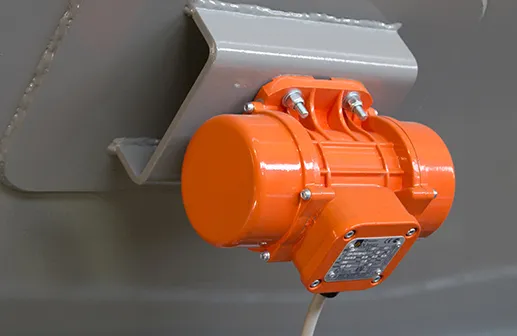
To promote uniform discharge, especially with wet, cohesive materials or materials that tend to compact, vibrators or pneumatic hammers can be integrated. These devices help prevent bridging, static arches and deposits, improving flow continuity.
Dosing and material control
Hoppers can be configured to manage material dosing in a simple or advanced way, according to production requirements.
In systems with timed dosing, the discharged volume is calculated according to time and the nominal flow rate of the extraction system. This solution is suitable for homogeneous materials and repetitive cycles where flow consistency is required. When more precise control is needed, hoppers can be equipped with load cells and weighing systems. This configuration makes it possible to monitor handled quantities, control recipes, trace batches and manage the process with greater precision.
Materials, structure and customization
Poggi hoppers are designed to ensure mechanical strength, durability and operational continuity. Depending on the configuration, they can be manufactured with a galvanized or painted steel body and a hot-dip galvanized support structure. Primary versions can be designed with thick steel plates and structural reinforcements to meet the needs of demanding environments and abrasive materials. Configurations can be defined according to the available space, required capacity and type of material to be handled. Hoppers can also be equipped with internal linings designed to increase wear resistance, reduce friction and build-ups, and improve material sliding.
Accessories and options for industrial hoppers
To adapt to different operational requirements, Poggi hoppers can be integrated with a wide range of accessories and options:
- Level control and monitoring: analog or digital systems for detecting the loading level and monitoring residual material
- Load cells: systems for measuring and controlling handled quantities
- Extractor belts: solutions for continuous material discharge
- Pneumatic discharge outlets: devices for controlled material release
- Vibrators and pneumatic hammers: systems to improve flow and reduce the risk of obstructions
- Moisture sensors: devices for real-time control of the material’s moisture content
- Internal compartment divisions: configurations for managing different materials within the same structure
- Equipment for severe climates: protective covers, insulation, anti-freeze systems and solutions against dust, moisture or rain
- Safety and accessibility features: guardrails, ladders, inspection hatches, safety sensors, warning lights and emergency stop systems
Application sectors
Poggi TR and TRP Series hoppers are used in multiple sectors where bulk material management requires continuity, resistance and adaptability:
- Construction, concrete production and precast: for the continuous and controlled feeding of aggregates, inert materials and premixed materials — hoppers for aggregates, hoppers for rubble, hoppers for concrete, hoppers for demolition debris
- Environmental and agricultural industry: for the containment and management of compost, fertilizers, flour, seeds and dry or granular by-products
- Recycling and material treatment: for applications requiring robust containers, wear resistance and compatibility with extraction and dosing systems
- Bioplastics, pellets and biomass: for handling wood chips, granules, flakes and light bulk materials
- Multi-sector industrial applications: for lines requiring regular feeding, simple integration and customized configurations
Advantages of Poggi hoppers
TR and TRP Series hoppers are designed to offer high performance in terms of reliability, flow continuity and integration with dosing and conveying systems.
- Reinforced structure, suitable for continuous loads and abrasive materials
- Engineered internal geometries to reduce material bridging and blockages
- Modular or customized configurations to adapt to complex layouts
- Compatibility with weighing systems, flow control and automatic or manual feeding
- Integration with belts, screw conveyors and dosing systems
- Replaceable wear components, to simplify maintenance and extend the service life of the solution
How to choose the most suitable hopper
The choice of hopper depends on several technical and operational factors. Before defining the configuration, it is important to evaluate:
- type, particle size and behavior of the material;
- required flow rate and flow continuity;
- loading and discharge methods;
- need for weighing or dosing;
- presence of abrasive, wet, compact or cohesive materials;
- available space and line layout;
- any requirements for automation, remote control or traceability;
- maintenance, accessibility and operational safety requirements.
Thanks to its technical know-how, Poggi develops hoppers adapted to customers’ real needs, from the choice of configuration to integration into the production process.
Conclusion
The TR Series inline hoppers and TRP Series primary hoppers are professional, multifunctional, robust, configurable and reliable solutions for bulk material management. The former are designed to feed the production line continuously and in a controlled way; the latter are designed to receive material in the initial stages and distribute it towards the following processing phases.
To identify the most suitable configuration for each process, it is possible to rely on Poggi S.p.A.’s technical experience and its ability to develop customized solutions for the storage, feeding, dosing and handling of bulk materials. For more information about the product, click on the links: Inline hoppers for material storage | Poggi and Industrial primary hoppers for aggregates | Poggi.