Inert materials are widely used in construction, concrete production, quarrying and numerous industrial processes. Sand, gravel, crushed stone and other aggregates can have very different characteristics in terms of particle size, bulk density, moisture and behaviour during handling.
Understanding the characteristics of inert materials is important not only for their use, but also for correctly defining inert material storage, feeding and transport methods within production processes.
Depending on the material and its particle size, silos, hoppers, belt conveyors and other systems designed for bulk material handling can be used.
What are inert materials?
The term inert materials refers to materials of natural, artificial or recycled origin whose physical properties make them suitable for numerous applications, particularly in construction and concrete production.
In technical terminology, the term is often associated with aggregates, meaning granular materials used individually or together with other components to produce mixtures with specific characteristics.
Inert materials can have very different particle sizes, ranging from fine fractions such as sand to gravel, crushed stone and coarser aggregates. These differences directly influence how the material is stored, dosed, transported and used.
What are the main types of inert materials?
The main inert materials used in construction and industrial processes include:
- sand;
- gravel;
- crushed stone;
- grit;
- aggregates of different particle sizes;
- materials obtained from crushed rock;
- recovered and properly processed aggregates.
The origin and characteristics of the material determine its possible applications. Even apparently similar materials can behave differently during storage or transfer due to particle size, particle shape, moisture and bulk density.
What is the difference between inert materials and aggregates?
The terms inert materials and aggregates are often used with similar meanings, particularly in everyday language and in the construction sector.
The term aggregate more specifically refers to granular material used in the production of concrete, mortar and other mixtures. The term inert material is used more broadly to identify different types of granular materials employed in construction, quarrying and other production processes.
From an industrial handling perspective, understanding the physical characteristics of the material is particularly important, as they influence the choice of solutions used for its storage and handling.
What are inert materials used for in construction?
Inert materials in construction are used in numerous applications. They are a fundamental component of concrete and mortar and are also used for sub-bases, fills, paving and infrastructure projects.
In concrete production, for example, aggregates with different particle sizes are dosed together with the other components according to defined quantities. Constant material availability and accurate feeding therefore become important factors in ensuring continuity throughout the production process.
Aggregate storage and handling are therefore directly connected to their subsequent use.
Where and how are inert materials processed?
Inert materials can be extracted, selected, crushed and classified in quarries and processing facilities, or they may come from recovery processes. Depending on the application, the material is separated into different particle sizes and subsequently accumulated or stored before the next production stages.
In these environments, even large quantities of material may need to be handled while ensuring a regular flow between receiving, storage, dosing and transport.
Primary hoppers for aggregates, for example, can provide the first material receiving and feeding point, particularly in applications characterised by high throughput and intensive operating cycles.
Inert materials, fine fractions and powders
The processing and handling of inert materials are not limited to coarse materials. Different processes may also involve fine fractions and powdered materials, which require different handling methods compared with gravel, crushed stone or coarser aggregates.
When materials have a very fine particle size, flow characteristics, tendency to compact and potential dust dispersion become factors that must be considered when designing storage, loading and unloading operations.
Powder storage therefore requires solutions suited to the specific characteristics of the material and to the way it will subsequently be discharged, dosed or transferred.
Silos and hoppers can be configured according to the material characteristics and integrated with systems and accessories designed to promote regular material flow during the different operating stages.
How are inert materials stored?
Inert material storage must be designed by considering the quantity, particle size, bulk density, moisture, material abrasiveness and the method by which the material will subsequently be discharged.
There is therefore no single solution suitable for every material. Depending on the application, hoppers, silos or different storage and feeding configurations can be used.
Hoppers are particularly suitable when different types or sizes of aggregates need to be received, separated and fed. Silos are used when the characteristics of the material and the process require controlled vertical storage, particularly for fine granular materials and powders.
In the construction and mining sector, Poggi develops products for the storage and handling of aggregates, minerals, powders and other raw materials.
How are inert materials handled?
After storage, the material must be transferred to subsequent processing, weighing, dosing or utilisation stages. Inert material handling must ensure a throughput suited to production requirements and a material flow that is as consistent as possible.
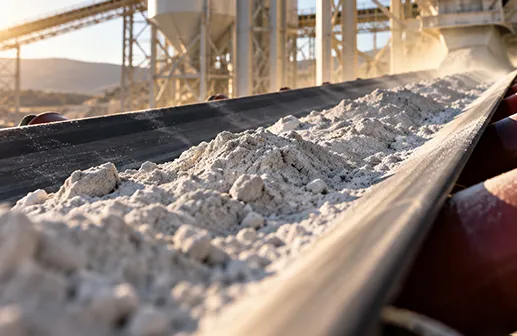
For sand, gravel, crushed stone and other aggregates, one of the most widely used solutions is belt conveyors for aggregates, which allow material to be transported continuously between hoppers, loading areas, dosing systems and subsequent process stages.
The length, belt width, inclination and conveying capacity must be defined according to both the available space and the characteristics of the material being transported.
Which solutions can be used for inert material storage and handling?
The choice of solutions for inert material storage and handling always depends on the characteristics of the material and the requirements of the production process.
Particle size, material quantity, bulk density, moisture, abrasiveness, required throughput and available space all contribute to determining the most suitable configuration. Silos, hoppers and conveying systems should therefore not be considered as isolated elements, but as components of a process in which the material must move in a controlled manner from one stage to the next.
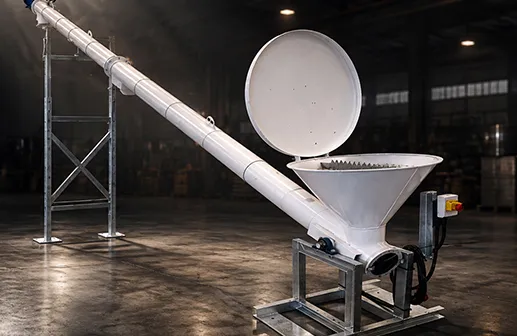
Poggi designs and manufactures products and solutions for the storage and handling of bulk materials across different industrial sectors. For inert materials, the range includes hoppers for receiving, storage and feeding, silos suitable for specific material types and belt conveyors that can be configured according to operating requirements.
The correct combination of these solutions makes it possible to handle materials with very different characteristics, from coarser aggregates to fine fractions and powders, adapting each configuration to the requirements of the process.